Die Cutting Custom Shapes: How Packaging Dies Control Cost
Die cutting custom shapes turns a flat printed sheet into a repeatable packaging blank with cut edges, crease lines, windows, tabs and locking features in the positions defined by the approved dieline. The custom part is not limited to an unusual outer silhouette. A standard-looking folding carton, corrugated mailer, paper insert or hang tag also depends on die-cut geometry to fold, close and hold the product correctly.
For a buyer, the practical question is not whether die-cutting is “custom.” Most branded packaging is custom at this stage. The useful questions are which features require new tooling, which parts of an existing structure can be reused, and what must be approved before the production run begins.
What the cutting die actually controls
The dieline is the two-dimensional engineering plan. It shows the panels, cut paths, crease positions, glue areas and any openings needed for the finished structure. The production die then transfers that geometry to the printed or laminated sheet.
That geometry controls several jobs at once:
- The outside profile of a folding carton, sleeve, tag or insert
- Fold and crease positions that let panels form without guessing
- Tuck tabs, locking tabs and glue flaps
- Windows, finger notches and product-reveal openings
- Paper or corrugated insert cavities and dividers
- Repeated blanks arranged for the following folding or gluing stage
This is why a custom shape should be treated as structural engineering rather than decoration. A foil logo or spot UV area changes the surface. A changed panel, tab, window or insert cavity changes the physical blank and can change the die requirement.
JCL includes structural dieline work in the project process. You send the product dimensions, quantity, material direction and finishing ideas; the pre-press team prepares the structure before artwork is placed and checked. The detailed custom box dieline artwork guide explains how to keep cut, crease and artwork information clear before production.
When a die can be reused
A production die can normally be reused when the physical structure and dimensions stay unchanged. That makes repeat orders simpler: the same cut and crease geometry can be run again while print artwork, color or selected surface finishes are updated within the approved panels.
Reuse stops being reliable when the geometry changes. A new finished size, moved fold, different closure, added window, changed insert cavity or altered panel layout needs a fresh structural review. Even a small dimensional change can affect how panels meet after folding, so it should not be handled by stretching artwork over an old dieline.
The most economical approach is therefore to stabilize the structure before multiplying designs. If several SKUs use the same box dimensions, one approved structure can support different printed versions. If every SKU has a different bottle, device or product set, the insert or outer structure may need to change even when the branding looks similar.
The factory quotation should separate the packaging specification from assumptions about reuse. Send the existing dieline or a physical sample when available, then confirm whether it matches the new product dimensions. JCL can also reverse-engineer a supplied box and recommend the appropriate material, structure and finishing path.
Real factory evidence: die-cutting and waste stripping
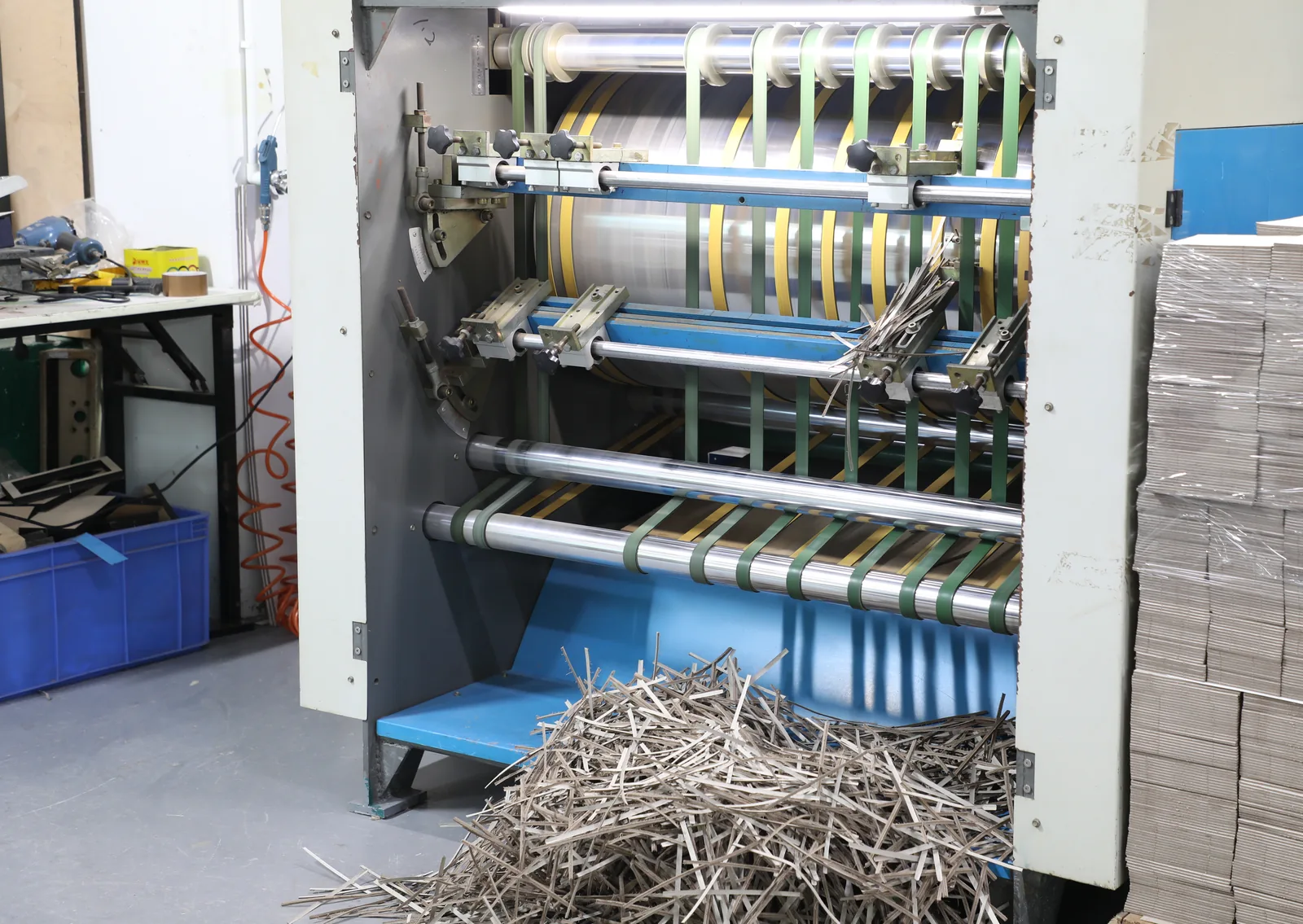
The factory photograph above is cataloged as die-cutting, waste stripping and stacking. It shows an automated production line, removed narrow waste material collected below the machine, and stacks of converted board beside it. The image matters because it proves the step between a flat sheet and a clean blank; it is not a generic picture of finished boxes.
Waste stripping removes the unwanted material around and inside the useful blank after cutting. The usable blanks then move to the next process, such as folding, gluing, insert assembly or rigid-box forming. JCL lists an automatic die-cutting machine and an automatic box-gluing machine in its production fleet, alongside film lamination, flute lamination, hot foil stamping, V-grooving and rigid-box visual positioning. The broader sequence is shown on the factory capabilities page.
The important buyer check is not the machine name alone. It is whether the approved dieline, printed sheet, crease behavior and finished sample work together. A cleanly cut blank can still fail if the panel dimensions, material or closure were wrong at the design stage.
Die-cutting choices by packaging type
Different packaging lines use die-cutting for different structural purposes. The table below uses JCL’s published material, MOQ, sample and production specifications.
| Packaging type | What die-cutting defines | Published material and structure | Standard MOQ | Sample and production |
|---|---|---|---|---|
| Folding cartons | Panels, tuck ends, auto-bottom parts, sleeves, windows and glue flaps | 250–400 gsm white/art cardstock, kraft, metallic or specialty stock | 1,000 pcs | 3–5 day sample; 10–15 day production after approval |
| Corrugated mailers | Roll-end profiles, locking tabs, trays, dividers and product cavities | E-flute, B-flute, C-flute or BC double-wall board | 1,000 pcs | 3–5 day sample; 10–15 day production after approval |
| Rigid boxes | Wrap components, paper inserts and supporting shaped parts around the greyboard structure | 1200–2000 gsm greyboard with printed or specialty-paper wrap | 500 pcs | 5–7 day sample; 12–18 day production after approval |
| Tags and cards | Outer silhouettes, holes, slots, rounded profiles and presentation shapes | 300–800 gsm art, black, kraft or cotton-core card | 500 pcs | 2–5 day sample; 7–12 day production after approval |
For retail cartons, start with custom printed boxes when the package should ship flat and present the product on shelf. For courier-ready structures, corrugated mailers and shippers provide E-, B- and C-flute options plus die-cut trays and dividers. For premium sets, custom rigid boxes can combine a pre-formed greyboard box with EVA, molded pulp, vacuum-formed, silk or corrugated inserts.
The same outline is not automatically suitable across these materials. Cardstock, corrugated board and rigid-box components fold and assemble differently. Confirm the exact material and finished structure before approving the die rather than treating a visual outline as a universal cutting file.
How custom shapes affect the quote
Die-cutting cost is connected to the full specification, not to shape alone. Quantity determines how fixed preparation is distributed across the run. Material affects sheet use and converting behavior. Size affects how blanks are arranged. Windows, inserts, multiple components and later folding or gluing steps add production work. Printing and finishes remain separate decisions even though they must register to the same structure.
This is why “custom shape” does not automatically mean an uncontrolled premium. A well-defined structure can be quoted as one repeatable production system. The risk comes from approving the look before the geometry, changing dimensions after tooling, or using a complex opening that does not solve a product or presentation problem.
A practical design review should ask:
- Does the shape protect, display, dispense or organize the product better?
- Can several SKUs share the same finished dimensions?
- Does the opening leave enough board around the product?
- Will the structure ship flat or pre-formed?
- Does the insert hold the product without unnecessary outer volume?
- Are print, foil, embossing or spot UV areas safely positioned against cut and crease lines?
- Has the physical sample been folded, loaded and viewed from every side?
The approval sequence before mass production
JCL’s published workflow begins with inquiry and quote, then dieline and artwork, a physical pre-production sample, mass production, QC inspection and worldwide delivery. The sample uses the actual stock and specified finishes, and production begins only after sign-off.
For printed work, CTP plate preparation and Heidelberg CD102 or PM74 offset printing come before the later converting stages. Film lamination or another specified finish may follow. Automatic die-cutting creates the cut-and-crease geometry; folding, gluing or box assembly then turns the blank into its final form. Every shipment passes a final AQL inspection with photo reports before packing.
Approve the structure at three levels: the flat dieline, the physical sample and the packed product fit. A screen proof can confirm artwork placement, but it cannot prove that a tab closes smoothly or that an insert controls movement. The sample is the point where material, geometry, printing and finishing become one object.
Send the product dimensions, weight, quantity, preferred packaging type, artwork status and any required openings or insert compartments in the first brief. JCL returns a detailed quotation within 24 hours and can provide worldwide express, air, LCL or FCL sea freight, including DDP door-to-door options.
Send your product dimensions and custom-shape requirements to receive a dieline and production recommendation for the correct box, mailer, insert, tag or card structure.